
Casino streamers and fake balances
Nobody had to expose them.
They said it out loud.
You don’t need a leaked contract to know that plenty of casino streamers play with casino money. They’ve been explaining it themselves for years, and one of them has it written on his profile right now. Here’s what they’ve said about their own deals, what the famous accusations are actually worth, and why the balance on screen tells you far less than you’d think.
Whose money is on the screenYou’ve seen the clip
Someone puts $5,000 on a single spin, loses eight in a row without so much as a flinch, then lands a six-figure hit, and by the next morning it’s done two million views. By the end of my time on Stake, the whole site felt built around moments like that, and it was a big part of why I went looking for somewhere else.
My own experience is set out in the Duel and Stake comparison. Whether I trust the casino with another deposit is a broader question, covered in my Duel legitimacy review.
The balance in clips like that is usually real. What it can’t tell you is whose money it is, or how much of it the person spinning could ever actually take home, and that’s what this page is about. I’m not here to sell you a conspiracy theory, so I’ll start with what streamers have said about their own deals, because none of that needs interpreting, and then go through the accusations everyone loves to repeat, most of which are a lot flimsier than the clips make them look.
Start with the one who just tells you
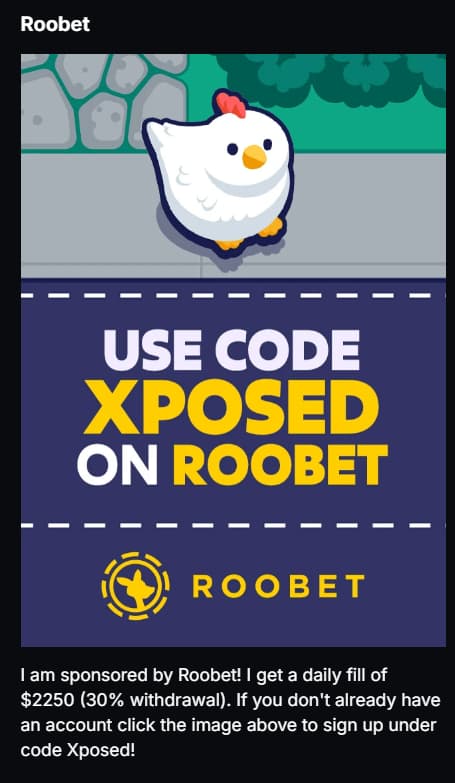
Submerzed streams casino content on Kick, which is where most of this scene ended up after Twitch banned slots streams from unlicensed casinos in October 2022. He doesn’t hide his deal at all. It’s sitting in plain text on his public profile, no leak or blockchain detective work required: he’s sponsored by Roobet, he gets a daily fill of $2,250, and he can withdraw 30%.
Read that last bit again. The casino tops his balance up by $2,250 every day, so when you watch him lose $2,000 on a bad run, he hasn’t lost a penny that was ever his, and when he hits $10,000, he isn’t walking away with $10,000 either.
I’m not having a go at him for it. He’s disclosed it, which already puts him ahead of most of the industry, and that’s exactly why I’m starting with him, because it shows you what the arrangement looks like when nobody’s bothering to hide it.
xQc explained the deals. Trainwreck put a number on his.
xQc is one of the biggest streamers on the internet and gambled on stream for years, and back in 2022 he talked openly about how these deals work. He drew a clear line between his own arrangement and the kind where the casino supplies the balance, and for those other deals, where both the risk and the reward get cut, his own words for what you end up watching were “fantasy” and “fake”.
That’s the bit worth sitting with. It isn’t a journalist’s take or a rival throwing mud, it’s one of the highest-profile gamblers in streaming describing the model and calling it what it is.
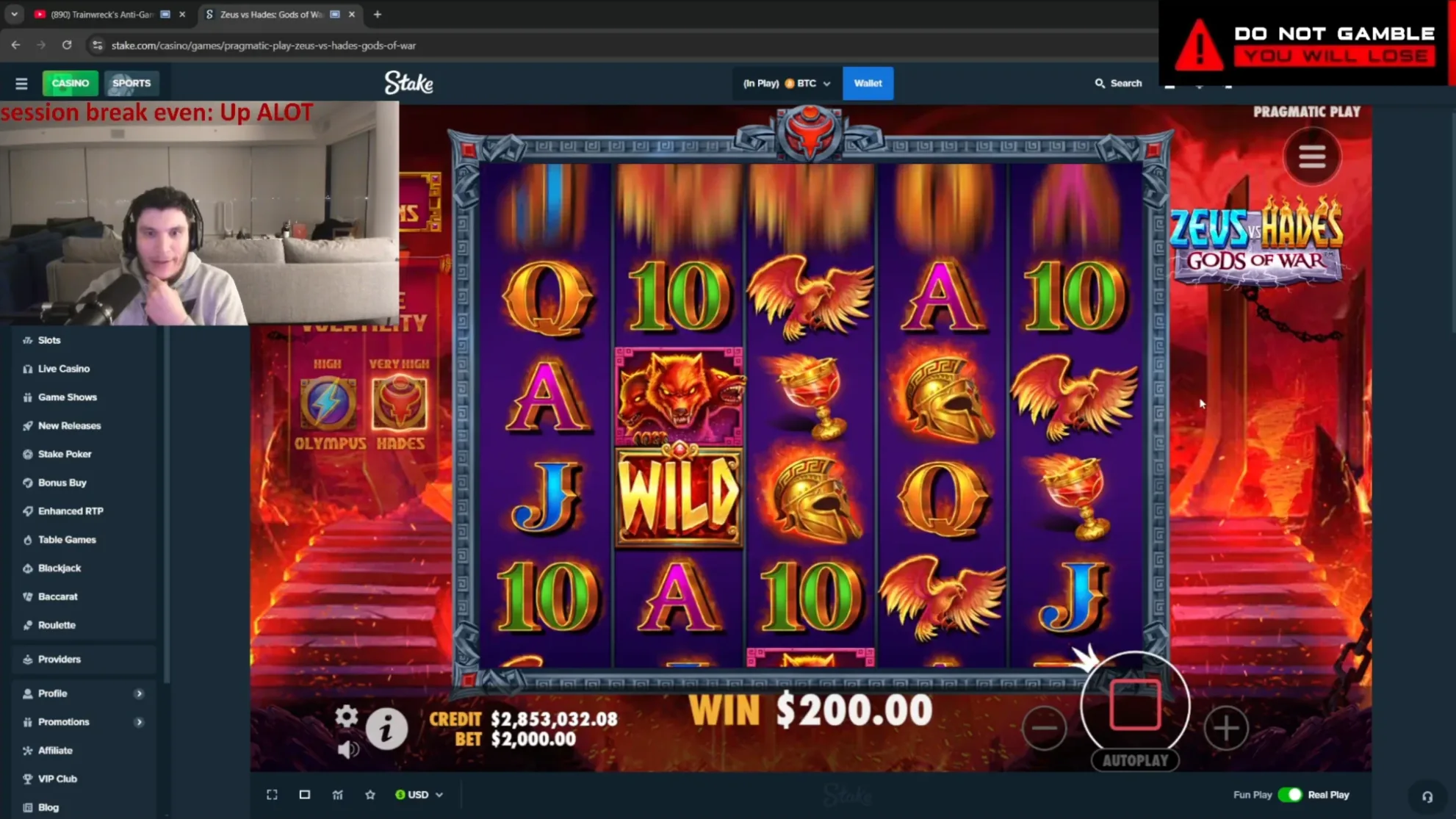
Trainwreck has spent years going after fake-balance streamers, which makes his own numbers worth knowing. In October 2022 he told his stream he’d been paid $360 million for 16 months of gambling. That’s a sponsorship fee, not a balance someone quietly tops up, and I’m not suggesting the money he plays with is anything other than his own.
It’s still worth keeping in mind when you watch him put $2,000 on a single spin with more than $2.8 million sitting in his balance. A spin like that just doesn’t mean the same thing to someone who’s been paid $360 million to gamble on stream as it would to you or me.
 Watch the clip on Kick
The accusations, and what they’re actually worth
Everything above is someone describing their own arrangement. What follows is different, because these are allegations other people have made about named streamers. I’m not making them, none of them has been proven, and I’m only including them because they’re the cases everyone cites and they hold up very differently, which is worth knowing before you repeat one.
Read the three allegations and the evidence against them
Roshtein and the demo-mode balance
This is the one you’ll see quoted most. The story, as forum threads and casino blogs have retold it ever since, is that during a 2019 stream Roshtein opened a slot in demo mode and the balance showed the same €22,113.10 he’d had in real play, when a demo balance is normally a round number.
He said it was a bug on the site, N1 Casino backed him, and there’s no reporting from the time left to check any of it against. It’s also hard to square with him landing the Book of Shadows jackpot twice in 2021, because jackpots don’t exist in demo mode, so it stays a long-running allegation that nobody can settle now.
AyeZee and the Rollbit wallet trail
In 2021 and 2022, community investigators traced transactions they said showed money leaving Rollbit, passing through Binance and arriving back at the casino as AyeZee’s deposits, including one transfer of around 86 ETH where the amounts and the timing lined up. On paper, it was the strongest follow-the-money case anyone had put together.
The original exposé has since been taken down, but the odd part is that the wallet’s still there, labelled with his name on Etherscan and open for anyone to scroll through. It still can’t settle anything, because once money passes through an exchange like Binance, there’s no way to show on the chain where it came from. It stays an allegation, and a good lesson in how quickly evidence like this rots.
The leaderboard win that went missing
In October 2024, Trainwreck pointed out that Roshtein’s reported $24 million win on Brute Force wasn’t on Nolimit City’s public leaderboard while his own wins were, and argued that meant Roshtein was playing on a promotional account. It spread fast, mostly because it rested on a real leaderboard rather than vibes.
The next day, Roshtein opened that same leaderboard on stream and showed the win sitting at the top. Nolimit City didn’t explain the delay, but the accusation as it was made didn’t survive, and that’s exactly why I’ve included it: a viral exposé tells you nothing about whether the thing it’s exposing is true.
I give the disclosures more weight than these viral accusations. That’s one disputed oddity from 2019 that can’t be checked any more, one money trail that can’t prove what it claims, and one accusation that fell over live on stream. Put them next to a streamer who writes his daily fill on his own profile, and the boring disclosures are worth more than every viral exposé put together.
Four different things, one lazy word
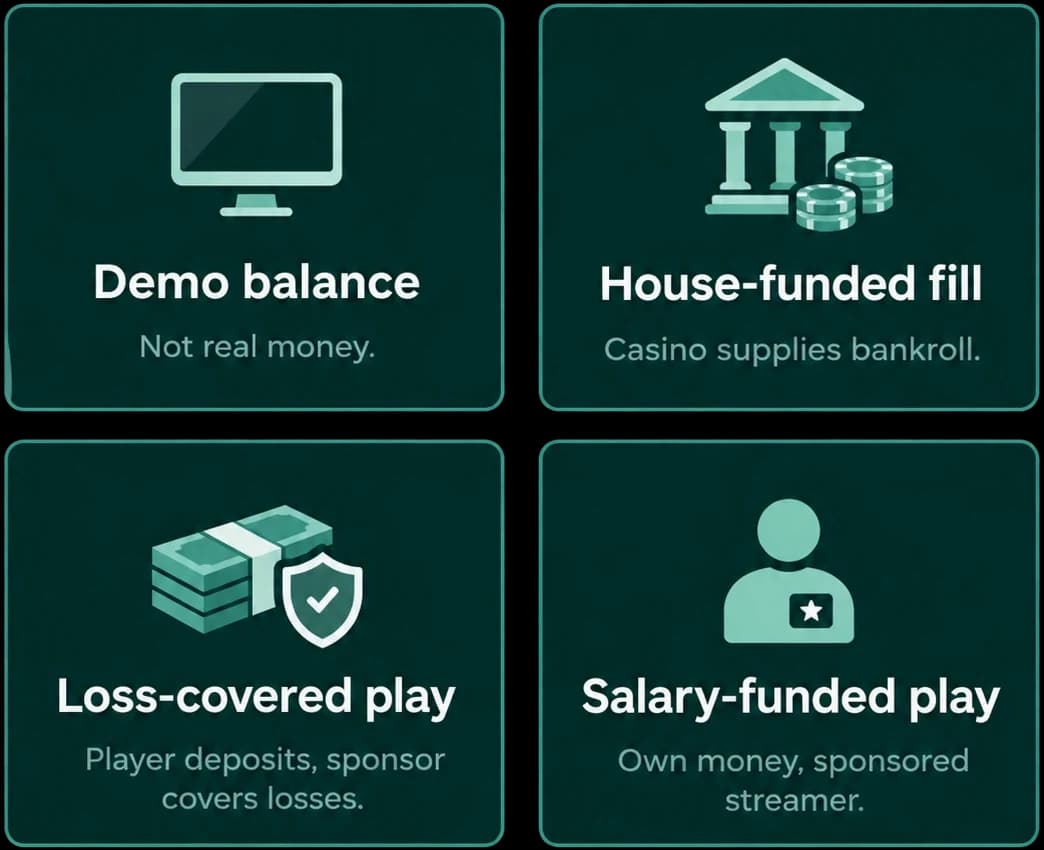
“Fake balance” gets used for all of it, which is half the reason the argument never goes anywhere, because there are at least four different arrangements hiding under that one phrase and they’re not equally bad.
The four arrangements, and the Brazilian reporting
A demo balance isn’t real money at all. It’s the rarest of the four, and the best evidence that it happens comes from Brazil rather than Twitter. In January 2025 three influencers there were arrested, with prosecutors alleging they faked jackpots on a demo version of a slot and sent their roughly 15 million followers to the real thing, and that April a police chief told a Senate inquiry under oath that illegal operators were handing influencers demo accounts to record fake wins on. The charges haven’t been tried and the inquiry’s final report was voted down, so neither is a finding, but it’s a long way from a forum thread.
The other three all involve real bets. A house-funded fill is the common one, where the casino supplies the bankroll and the streamer can often only withdraw a share of it, like Submerzed’s 30%. Loss-covered play looks completely normal on screen, because the streamer deposits their own money, but the sponsor covers the losses behind the scenes. Salary-funded play really is their own money, paid to them by the casino and gambled with normal withdrawal rights, but the sponsorship still paid for the bankroll you’re watching.
I would not call all four “fake money”. Only a demo balance is fake in that literal sense. The distinction I care about is who carries the loss and how much of the balance the streamer can withdraw, because that changes what the bet means.
Why this actually matters to you
Not because someone on the internet is being dishonest, but because of what all this does to your sense of normal. When hundreds of clips show ordinary-looking people hitting six figures, big wins start to feel within reach, when really they’re rare and the clips come from balances that can soak up a losing run you couldn’t.
It shifts what counts as a normal stake, too. Watch enough $5,000 spins and your own $2 spin starts to feel pointless, which is the whole commercial point of this content and where the real damage gets done. I put about $80 into my first session on Duel, and that’s a perfectly normal amount to play with. If watching this stuff has started to change what feels normal to you, that’s worth taking seriously.
And it builds trust by proxy. A streamer wagering millions on a site makes the site look solid, but if the millions came from the site, that signal’s worthless, and you only find out when your own withdrawal gets stuck. You can’t spot any of it by watching, whatever anyone tells you. What you can check is whether a streamer discloses the deal and whether they ever withdraw and show it, and almost nobody does the second one, which is why I show you my withdrawals on this site rather than my balance.
“A balance on a screen proves nothing until it leaves the casino.”
Where Duel sits on this
Duel says there’s no fake-balance feature on the site and that every bet placed on it is real. I can’t audit anyone’s streamer contracts, Duel’s included, and I’m not going to pretend otherwise, so take that for what it is: a casino telling you where it stands.
It’s worth being clear about what a statement like that covers, too. Whether the bets on a site are real, whether a streamer’s overlay is showing you the truth, and whose money is actually at risk are three separate questions, and a casino saying its bets are real only answers the first. The other two come down to the streamer, which is why a disclosure like Submerzed’s tells you more than anything a casino puts out.
What I can tell you is why I ended up here. I liked Duel’s advertised 100% RTP on its own games, and the money I withdrew reached my wallet. Those are reasons for my preference. Neither proves the terms of a streamer’s contract, so Duel’s statement still gets the same scrutiny as anyone else’s.